Posts

Showing posts with the label #Classen

Touch: a low sense with high connection

Image
 Touch: a low sense with high connection How I connect touch in direct care to my religious practice In my time as direct care staff I have worked through several levels of physical contact. When I began as an intern I was unable to make any supporting physical contact with individuals. This meant that I was able to haigh-five and occasionally hug participants but unable to assist those who needed physical support to be mobile. I could push a wheelchair if the individual was capable of driving it themselves but unable to walk with an individual who uses a gait belt. In the beginning, I often felt like I was unable to help. I would see other staff stretched very thin and needing extra hands to make sure all the individuals were getting their needs met. I was unable to step in and provide the support they needed. During this time I did a lot of watching. I reminded myself that an important part of my experience was just to be proximate to this type of need. Historically the individua...

Real Experiences

      Coming fresh out of a pandemic, I believe one of the most important claims in the books we have read is Classen's in which she describes the importance of touch and tangible experience. Why do humans see concerts in person, when they could stream the same music online without spending nearly as much money or time? The answer is obvious —we are willing to pay a price to be part of a shared, tangible experience or to connect to someone special.       You might not think that for students as stubborn to participate and uninterested in learning as us that being in a classroom is preferred over zoom. Actually, upon coming back to campus, I heard endless remarks of those being happy just to be back in the classroom setting. They couldn't figure out why. Agreeing with Classen, it's because we need this tangible experience to learn effectively. You've probably heard about the "zoom fatigue" experienced by many during this time, and I have to agree. The r...

Touch in the Museum

Image
One topic that stood out to me as interesting in The Deepest Sense: A Cultural History of Touch was the historical role of touch in museums, and how it was eventually phased out, replaced primarily with sight. Most people probably think of museums as being a strictly no touch zone, as a way to protect important historic artifacts from being damaged or worn by human contact, but even in a modern context there are plenty of museums where touch is still an active part of the experience. The museum that comes first too mind when I think of a museum that encourages touch is a children's museum, such as Boston Children's Museum, a place I have many happy childhood memories of. The goal of a children's museum is to be a place for children to play, learn, and learn through play, and many of these playful experiences are certainly tactile ones. Despite being primarily aimed at Children these experiences can be just as fun for adults too, and some children's museums, including B...

No-Touching Stores

Classen’s idea of often being warned not to touch things and then feeling reluctant to really examine and discover things in the world  reminded me of when I was a little kid, my family would go into fancy shops and they would be “no-touching stores” for me and my sisters. When my family would be out exploring a new town, as we did a lot as I was growing up, we would go into pretty much any store that any of us wanted to. Some of them were toy shops, thrift stores, or random chains, but sometimes my parents would want to go into “grown-up stores”, and by that I mean a store with a lot of breakable items. I feel like in most families, one parent would go inside the store and the other would stay outside with the kids, but my sisters and I were well behaved so we got to go into the fancy stores. The rule was, though, that we could go in but we weren’t allowed to touch anything there, so that kind of store quickly became known among the whole family as “no-touching stores”.  I th...

Seeing and Touching: Distance and the Sacredness of the Senses

 In her book Darsan: Seeing the Divine Image in India Diana Eck discusses the importance and role of vision in Hindu religious practices. One element of this that stood out, is how the idea of looking in Hindu practice seems to be reciprocal. Looking upon the statue of a deity is a significant religious act and so is being looked at by one. The gaze of a newly sanctified statue is considered powerful enough that when their eyes are painted on they must not be looking directly at someone. This significance of looking, with vision having the power to transfer blessings and curses between humans and gods is particularly interesting when considered in comparison with other religious contexts. In The Deepest Sense: A Cultural History of Touch by Constance Classen, an important topic is the importance of touch in Medieval Christianity. During the era of relics, a different example of a religious object thought to be imbued with holiness, in some sense, and able to bestow its blessings on...

Orbeez and Artwork

Image
When my sister was little, she was obsessed with Orbeez and had approximately a gazillion of them. If you've never touched them, they remind me a bit of boba (which is part of the reason I refuse to even try boba tea). I was pretty quickly banned from touching them on account of they were really fun to squish because they would pop in half but it's "not nice to break your sister's things." I kept doing it anyway. Anyway, I was really interested in what Classen had to say about early museums and the expectations of touching the things on display, especially with how museums transition to no longer allowing touch. Orbeez have no real value outside of touch. They're kinda fun to look at, but not that interesting, they have no interesting smell or sound, and while I've never tried tasting one... please don't taste Orbeez. But, there's no real point in having them unless you're able to touch them.  At the same time, though, my sister's gazillio...

A Mother's Writing (Touch)

     Something that has always fascinated me is women’s history. And by this, I mean the real history of women, because it’s far too easy to get caught up in what men think women’s history is or the perception of women’s histories, which is lives of pain and hurt and motherhood. Most narratives of women who fall outside of that, however, were the ones privileged enough to write, which Classen talks about quite a bit in his book. The section on women’s work, and women’s writing, made me think a lot about a faculty presentation I was blessed to have been able to see earlier this semester: Professor Polanichka’s presentation for the History Club on her research on Dhuoda.        Dhouda is a noblewoman from medieval France born in roughly 800BCE; not much is known about her life except for her marriage to her husband, her two sons, and their fates. Her husband was thought to be treacherous so her eldest son was taken to live at court as a political hos...

Gender, Touch, and Myth

Image
It’s interesting how although touch was, and still is sometimes, seen as a “female sense,” it is also used in a religious context to “provide an infusion of divine virtue” (130) and to be closer to God. Especially considering that Christianity has been a male-dominated religion, it seems contradictory that touch is seen as both feminine and an authentic way to connect with God, a practice that historically prioritizes men over women. This stood out to me as I was reading Constance Classen’s The Deepest Sense, most likely because of her focus on Medieval European culture and religion. Can only women engage in the connecting sense of touch? Certainly, this isn’t practically true, but in terms of a conceptual patriarchy, I think women and touch are associated in order to exaggerate a separation between them and the wholly different intellectual men. Again, the prioritizing of reason, sight, literacy are Western norms, and not necessarily the standard in other cultures and religions. ...

Touch and Human Interaction

Image
 Reading The Deepest Sense: A Cultural History of Touch  by Constance Classen out into perspective how abnormal the conditions of the pandemic have made our social interactions. Classen's writing depicts the history of human interaction and everyday life as extremally intimate and interpersonal. Eating, living, and bathing were all communal activities in medieval times, and meals were served in shared bowls and hands were used instead of utensils. Post-COVID pandemic these things are inconceivable to us, this past few years being even in the presence of someone else has been considered potentially dangerous and I feel like it has warped my feelings about personal space and human interaction. I didn't grow up this way, my family was not big on personal space and my mom always communicated affection through physical touch. I would always wrestle or play rough with my cousins and siblings and it was not strange for me to hug a person I had maybe never met or had just met. I know ...

The Healing Touch

Image
 When I began the course, thinking about the senses and which one I thought took precedence, Touch was definitely not at the top of that list. Reading this in many ways reiterated just how deeply the sense of touch can affect, and has been affecting our lives. The way that the book explores significance of touch to an ailing individual was eye opening for me. It was also really interesting to see how during periods where leprosy was rampant, the lack of touch meant so much more than just 'no touching'. Not only were suffering individuals deprived of touch, but it also led to social isolation, which I believe is also a loss of touch in a more intangible manner, where they lost touch with their environments and the social scene of that time.  Reading about that made me reflect on what is going on in the world right now, as it related to COVID. We, as a society also recently went through a phase where we had to deprive ourselves fro touch in various ways. For me personally, the l...

Creative Misogyny

 It struck me as funny, just how much Classen talks about how misogynistic the Church is during the Middle Ages. The way the Church said "if ... 'men could see beneath [women's skin]' then they would be safe from the temptations of touch, since 'how can we desire to embrace such a sack of dung'" (76) is hilarious. They get points from me for creativity, at least.  A centuries-long history of homophobia within the Catholic Church seems almost ironic amidst these claims of how horrible women are--a disclaimer here is that I am a lesbian and grew up Catholic, though I no longer am. I sort of jokingly thought while reading a good majority of Classen's 'A Woman's Touch' chapter, "If they hate women that badly, why didn't think they think being gay is okay?" You know, women are "sack[s] of dung" (76) on the inside, so... just stop encouraging heterosexual marriage. Of course, I'm not serious about that, it's just s...

Elvis Lives

Image
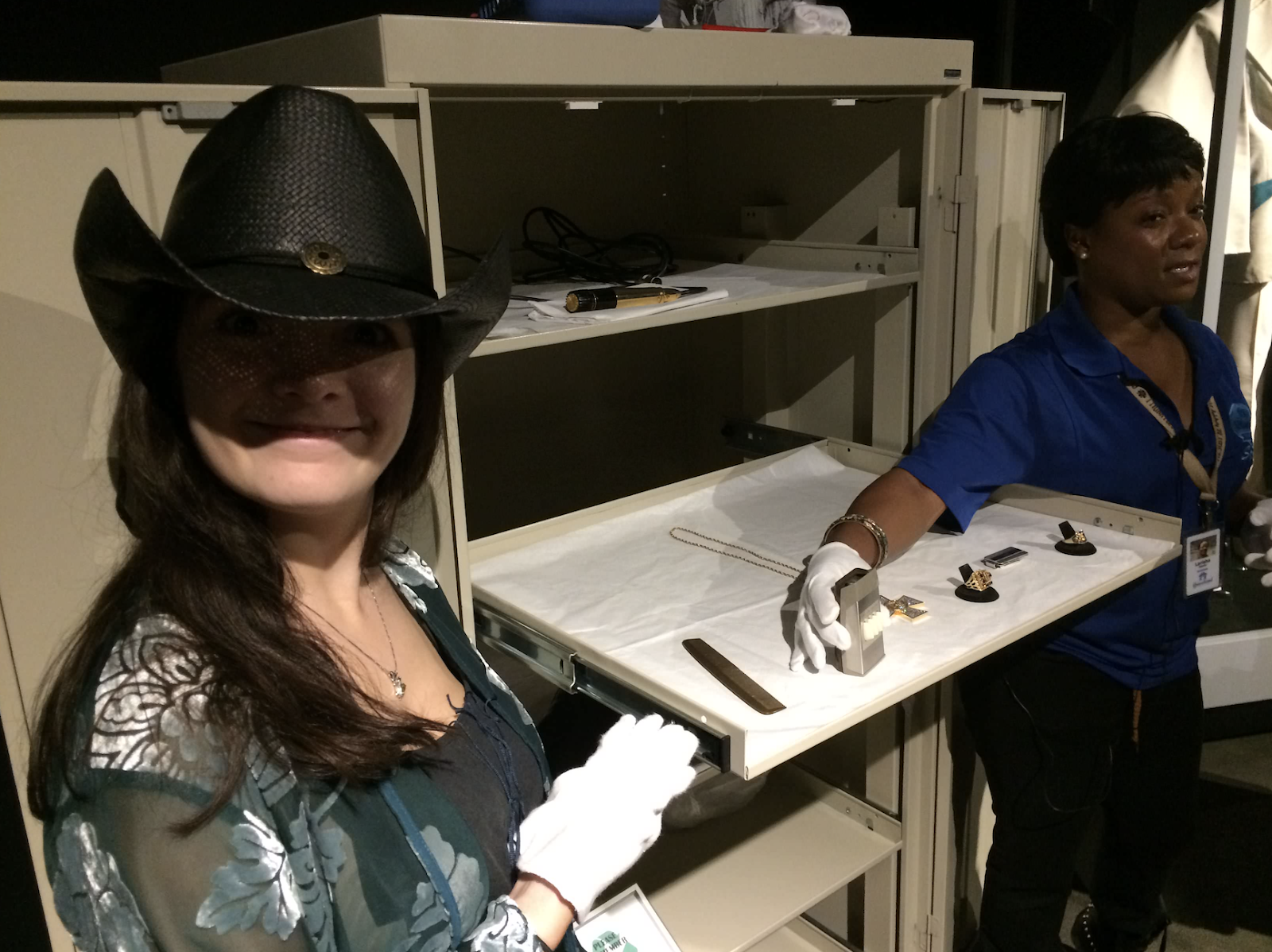
Another aspect of Classen and touch that I want to “touch” upon besides what I mentioned in our group presentation (the necessity of touch through Harlow’s monkey experiment and how fun games are when we include touch and not sight) is the noticeable omission of tactile experiences in museums. Exploring history through touch makes the past come alive. While reading, I was reminded of when my family visited Graceland and went to the Elvis Presley museum. Part of the VIP tour included holding Elvis’ microphone, jewelry, etc., and this is so important, not only for die-hard Elvis fans, but for everyone to experience because “when we allow historical figures to be of flesh and blood, we make it possible to relate to them as fellow beings and, therefore, to make meaningful comparisons between their lives and situations and our own.” I believe touch is one of the best ways that we can understand the past, and it should be implemented in history lessons more. (Pictured here is my sister about...

The Touch of a God

Image
I was raised in the Lutheran Church. The idea that God had allowed Himself to be embodied in the form of Jesus was omnipresent. He was not merely physical, though, He was human, and He had human experiences. Thus, He “could be approached as a broken body on a cross, as a baby nursing at his mother’s breast, or as a young man embracing a friend” (29).  I never fully grasped what this could mean because Jesus is no longer a physical presence in this world. His body was, in fact, minimized. As Protestants, the image of the crucifix, the Jesus who is in the midst of his agony, was not what we were taught to prize. Rather, we should venerate the empty cross. A pastor once said in a sermon that “Jesus isn’t on the cross anymore. Why dwell on Jesus’s suffering? What matters is that he rose again!” We were taught to see him as his spiritual self – his God self – not his human self. In my current pagan practice, my understanding of the deities is far different. They are not completely physi...

Why Touch Matters- And Why It's So Powerful

 It is no surprise that touch has been an important factor in well-being throughout history. The lack of physical touch, especially as a child, has been shown to lead to oversensitivity, hostility, depression, loneliness, and more. There is a reason that most newborn babies are placed on the stomach after birth—it provides comfort to both parties, allows the infant to become familiar with the scent of its parents, allows for a smooth transition into breastfeeding, and also releases oxytocin. Touch is a nurturing interaction between individuals, and it provides a strong ground for bonding and communication, as well as affirms social bonds, for example, receiving a handshake from an employer, or high-fiving a teammate after a game. It can also yield negative social bonds, as Constance examines in  The Deepest Sense, with pain being used to enforce religious expectations.  Physical touch can be as intimate as a handshake or a clasp of the shoulder, to kissing or sex. The int...

Don't Touch the Ducks

Image
  Whenever I think about touch I am always reminded of the touch and feel books I had as a kid, however this one sentence in Constance Classen’s book The Deepest Sense: A Cultural History of Touch “ It seems that we have so often been warned not to touch that we are reluctant to probe the tactile world even with our minds” has made me realize that I have never actually felt a real duckling’s down feathers because I’ve always been told not to touch the ducks so I don’t know if they actually feel soft or not, by the look of them I imagine they do, but I don’t know.  Image link: https://www.amazon.com/dp/B006U3RNEW/ref=dp-kindle-redirect?_encoding=UTF8&btkr=1 It made me realize just how many things we are told not to touch in our lives mostly for our own benefits like fire or a wild animal, but it also made me realize that people are often embarrassed to admit that they did things like burning themselves on a hot stove because they think its stupid that they did so. even if i...

Are speech and imagination "sixth senses"?

Image
Cover of Jeffrey Kripal's book Authors of the Impossible: The Paranormal and the Sacred "If, however, paranormal phenomena are meaning events the work and look a great deal like texts, then it follows that texts can also work and look a great deal like paranormal phenomena. Writing and reading , that is, can replicate and realize  [my emphasis] paranormal processes, just as paranormal processes can replicate and realize textual processes.  This is what I finally mean by the phrase 'authors of the impossible.'  It is also what I am trying to effect with this text." (Jeffrey Kripal, Authors of the Impossible , p. 26) This passage really struck me.  What do you think he means by it?   I think in it (and throughout his book) Kripal is offering some very provocative suggestions for what "the sixth sense" might be. Is it speech, as some have proposed both in the Western intellectual tradition  and in non-Western cultures, as David Howe and Constance Classe...

Touch as Trauma, Touch as Healing

Image
As a class, we explored the concept of positive healing touch quite a bit, how hugs and kisses can make people feel better and bring comfort, with it even being considered essential to proper development. While we did discuss how some people do not like to be touched all that much, or see physical touch as something that needs to be built up to when creating relationships with people, one thing I think we could’ve explored more is the idea of touch-related trauma. Often people who have been assaulted in some way, such as having been attacked or sexually violated, will find themselves having very complex relationships to physical touch and their own body existing as a physical thing. When you are assaulted, very often you will experience a sensation of dirtiness, a need to sit in the shower, and scrub in an attempt to rid your body of whatever trauma had occurred. Often after this very often an overall disconnect to the body will occur, with the victim losing the relationship they previ...

Touch Changing Our Lives

Throughout each and everyday of our lives we are constantly touching everything. I am currently touching multiple keys on my keyboard all at once, with my arm on the desk, sitting on my chair, with my feet resting on the floor. No matter what we are always feeling something through the sense of touch. However, touch can be so much more than just a feeling. As Constance Classen, the writer of The Deepest Sense: A Cultural History of Touch, describes it as being so much more than just a feeling. The bond of touching between loved ones, or the strict feeling of pain we get through touch. Through a religious standpoint the feeling of getting baptized, for Christians, can be an extraordinary feeling like none other.  For me when I was baptized the feeling was like none other. And I am sure that each and every person at some point in their lives have experienced some sort of touch that was like none other. It was special. And it shows just how the sensation of touch can be all that m...

Postmodern Touch, and Some Guy Getting Arrested in my Driveway Yesterday

Image
It feels almost ridiculous to write about touch at a time like this. Shaking hands, hugging, kissing, high fives, a slap on the back, a kiss, all are forbidden. It's been months since I've touched another person besides hugging one of the family members I'm quarantined with. I don't even know how I'll possibly readjust to interacting with people normally, or when I'll get the opportunity to make that readjustment. I've been managing alright, but I need to start being with friends soon. I think if there's something good that might come out of this, it will be a reevaluation of our hierarchy of the senses. Zoom, FaceTime, and many other bits of software can do wonders recreating our so-called "higher" senses of vision and hearing across time and space; I can talk to and see my friends without any issues at all. I'm sure that we are all in agreement, however, that this type of interaction is missing something, that it feels hollow. I don'...

A Touch-Up

Image
Touch is an interesting sense as far as I am confirmed, it is weirdly connected to a lot of negative things for me and this was definitely reaffirmed by Classen. I have felt funny enough that this seems to be one of the most negatively connected senses to religion, lots of pain and punishment is a direct result of touch especially in Western traditions like Christianity. An entire chapter of her book, The Deepest Sense : A Cultural History of Touch, is called Painful Times and focuses on a lot of what I have associated with my sense of touch, the deeply negative and painful connotations of the sense and how it may relate to history and religion. Though on page 49, she offers a simple sentence that forces me to think just a bit harder on the connection, “The roles of touching treatment, in turn, were myriad.” This sentence made me reconsider some connotations due to indexing of the really healing properties of touch. Though it may not be inherently religious in its context, healing do...