Posts

Showing posts with the label sense

Smell ya Later

Image
"Spices and perfumed oils do not endure over long periods of time, however, and the destruction of incense, through burning, is integral to its employment" (Green, 5)  After reading this, what struck me as interesting wasn't the actual fact, but rather, by conclusions to be made about the power(s) of scent and its limitations. Is the power of scent reliant on its state of temporality? This idea was further elaborated by the scientific notion of scents dissipating from our perceptions after a certain period of time. This corresponds with the phrase of spending enough time in a monkey exhibit, you no longer smell it. The longer you stay in an area and experience a particular scent, the less you experience and eventually it begins to fade into oblivion. The same can be said with certain skin receptors which are only activated once and then are only activated again when another touch or a change of touch occurs. The same applies with all of smells. Eventually we all get...

Can atheists trust their thoughts and senses?

Image
Christians will sometimes bring this up with atheists to show that atheism is an irrational worldview not realizing that Christians have similar contradictory thoughts on the subject. Other times, Christians will use this argument as a justification for ignoring atheists' arguments, which can actually work both ways because Christians also cannot know that they can trust their thoughts. Is atheism an irrational worldview? Can this question be answered using our senses? The main accusation being addressed in this interesting video is as follows: Atheists cannot know if their thoughts and senses are trustworthy. Here is an interesting take on atheism and the ability of atheists to trust their thoughts and senses without belief in a deity. Conclusion: The same can be said about Christians. Find out why by watching the video below. 

What does God smell like?

Image
In  The Aroma of Righteousness,  Deborah A. Green works to interpret and understand the role smell plays in jewish religious literature. One goal of this reading was to make the reader think about the religious use of scent, aroma, and smell in Judaism. But woven amidst all of this sensual analysis is a deeper question. What, or who is God? I have my own definition, but it is not something that I am very confident about and I struggle to clearly put it into words. The best I can do is say that God is an entity or energy. i don't want to presume to know what or how God manifests but my most recent guess is that God  G enerates,  O perates and  D estroys. This is a new definition for me and it is always changing. I have tried to define God from the perspective of the mind, of thought, of ideas but maybe there might be benefit in trying to answer this question by using my senses. In this reading Green attempts to show how rituals such as lighting incense he...

The Shape of Sound

Image
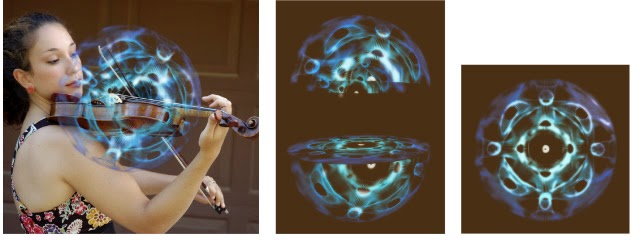
In Diane Ackerman's description of sound she says that sound is air molecules that move in waves that begin with the movement of any object. These waves enter the outer ear which is like a funnel and vibrates the eardrum, the hammer, anvil and stirrup bones (the tiniest bones in the human body) which press fluid in the inner ear triggering the cochlea hairs which signal nerves. However, there is one misconception present very early on in this explanation. Sound does not simply travel in waves . Instead sound travels in spheres . Scientist John Stewart Reid was the first to officially introduce this new understanding of sound. Here is an excerpt from his writing on the subject: " Sound in air is the transfer of periodic movements between adjacent colliding atoms or molecules. This sonic energy typically expands away from the site of the collisions as a spherical or bubble-shaped emanation, the surface of which is in a state of radial oscillation. The sonic bubble expands ...

Ocean

Image
Diane Ackerman brought to light a fascinating observation that I have never encountered before in her Natural History of the Senses. She shared that the ocean is inside of us. This idea really resonated with me. She begins by sharing that "Our sense of smell, like many of our other body functions, is a throwback to that time, early in evolution when we thrived in the oceans"(pg. 20). The blood in our veins, which mirror the tides in their pulsing is mainly salt water. Ackerman explains that "we are small marine environments on the move, with salt in our blood, our urine, our flesh, our tears" (149).  To  smell , an odor must dissolve into a watery solution before our mucous membranes can absorb it. The  smell  of the vagina has a history of being reported to smell fishy. Sponges a sea creature have a profound sense of touch that allows them to feel every quiver in the water. Our need for touch is first developed in the moving waters of womb w...

Smell: A higher sense in my book

Image
While reading Diane Ackerman's Natural History of the Senses, I was stormed up inside my boyfriend's apartment. It was a snow day after all, so I decided that I had to make a cup of hot chocolate the "old fashioned" way: by heating up milk on the stove and pouring it over a mix of 100% pure cocoa powder, sugar, and a touch of vanilla extract. While adding my ingredients together my boyfriend's roommate said from another room "that smells like the real stuff".  Pre Ackerman I probably wouldn't have payed much attention to the comment, however reading about "the mute sense" has made me much more in tune with it. I was suddenly amazed by our abilities to smell and was puzzled by why we all (myself included) take this sense for granted. If you were to ask me three days ago if I thought that people could use smell alone to tell the difference between different types of cocoa mix (Swiss Miss, Hersey's, Nestle, or packet vs. hom...