Posts

Showing posts with the label music

Islam Women, Kanye, and Tyler the Creator

As we have discussed in class and as Rasmussen also describes in her book, “Arabic flavored” Islam tends to be much more publically patriarical, while Indoneisan Islam includes and appreciates women in their islamic traditions, practices and beliefs. This generality kind of reminded me of christianity amongst white people vs christianity among black people in America.  Christianity by whites was often forced upon and used to oppress black people especially during slavery times and now just a few generations later many black families hold strong christian beliefs, which seems counterintuituve to many. I do not speak for anyone whatsoever, but from what I have experienced and witnessed many have in turn used it to persevere through the effects of that oppression, to restore and keep faith.  Wildly famous rapper and producer Kanye, for example, openly discusses his faith in his music and other media, often symbolizing Jesus and religion as safety and motivation to get through ra...

The Emotion of Sound

Image
The sense of hearing has many levels of importance to us such as hearing a loved one's voice, sensing a potentially dangerous situation, listening to music, or just simply hearing the sound of leaves crunch under foot in autumn. One of the first things I think about with the importance of hearing would be music. In Diane Ackerman's Natural History of the Senses she discusses this relationship that humans Our Christmas ornament from when I played trumpet.  have to sound and music and states that "the odd thing about music is that we understand and respond to it without actually having to learn it" which is one thing I find amazing about music and sounds in general (Ackerman, 205). I have long forgotten the details about scales, notes, and measures that I learned while playing trumpet in eighth grade, but that does not mean I cannot enjoy, appreciate, and feel emotions that the song evokes. Music is so universal regardless of language or genre and it can be enjoyed...

Religious Sounds

Image
Sound is so important for so many different faiths and religions because sound is how so many people communicate with each other as well as pray to their god(s) or deities. The one thing we can expect to find when attending a place of worship of any faith is song, prayer and talking. Sounds such as specking and singing are such a large part of cultures and we can clearly see this in the videos of showing people practicing parts of the Islamic faith.  Another large part of religion and faith when it comes to sound is music. One can find different types of instruments such as drums, guitars, pianos and many others being used while praying and worshiping god(s) and deities. There so are many ways to show that one is dedicated to their faith or religion and using music is key role way of showing dedication in many groups. Every religion has different approaches to how they wanted to use it, sometimes it depends on gender, age, location, position of power, language and inten...

The Wheatones Ritual

Image
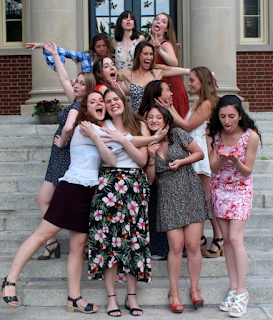
In class, we've discussed how many religious rituals usually involve some medium of music. The presence of music in these events helps to bind these communities and bring them closer together. I think that the Wheatones, an all female acapella group on campus that I am a member of, is involved in rituals that bind groups of people together. In as itself, the Wheatones meet in the same room, around the same time, four days out of the week. The purpose of the group is to create music arrangements and perform them using only voices, compared to instruments. We then learn the music through repetition and critiquing, and are usually offered to perform at events such as Relay for Life, nursing homes, children's museums of science, etc. When we are asked to perform it is usually to set the atmosphere for an event, or to unite the attendants of the event in one anthem. In this moment, everyone listens to the same tune in solidarity and potentially shares some of the same thoughts. ...

The Festivalization of Religion

Image
Muslim people engaged in Qur’an recitation in Indonesia would never describe what they are doing as music. Islam has a complicated relationship with music, and even beyond that the Indonesian definition of music require instruments. However, Anna Rasmussen claims that the recitation she is studying is a form of music. We discussed this in class, which made me wonder at what point chanting becomes music. I think the answer lies in the concept of the “festivalization of religion” that Rasmussen brings up in chapter four. There is a fine line between ritual and art. First, I do not believe that most people would describe their own rituals as a form of art. The application of that label requires an outsider’s perspective in many cases. Second, the Indonesian government encourages the performance of religion in a way that transforms ritual into art. This may be how Qur’an recitation can become music. When recitation becomes a public event and a competition, the intention behind it is tran...

Make it musical

Image
Street musicians in Chicago performing on buckets Throughout the reading, the same though continue to remain in my mind that Anne Rasmussen posed in the beginning of her writings: What is music?  Although the answer seems clear, there are people who find find ambient "background" noise as music. Is the difference in music or not that intention and effort put in? Even the presence of an instrument doesn't exactly equate to people considering it music. Think, for example, about a novice playing the saxophone (or many wind instruments, actually), people around them may say that it's not music and may even call it "racket". Older people talking about music of a younger generation may call it noise ("turn off that noise!"). This eliminates the idea that just an instrument is needed to indeed make something musical. For that matter; What is an instrument?  Colloquially, instruments pop into our heads that are made with the intention to produ...

Music and Memory: Alive Inside

Image
https://www.amazon.com/Alive-Inside-Dan-Cohen/dp/B00OPCF3EW When my grandmother was first diagnosed with dementia, my mother began researching the topic as a coping method but also because she wanted to be prepared for what was to come. She came upon a documentary called “Alive Inside: A Story of Music and Memory” which tells the story of the nonprofit organization Music and Memory providing music therapy for dementia patients. The documentary tells the stories of several patients and how the music therapy helped patients who had become catatonic be brought to life by the music of their past. We soon tested out this effect of music on dementia with my grandmother and found the connection between music and memory to be incredibly significant. As soon as the song “Tie a Yellow Ribbon Round the Ole Oak Tree” by Dawn featuring Tony Orlando came on, it was like someone had opened a window and my grandmother took her first breath of fresh air in months. She instantly began humming and ...

The Oldest Song

Image
Music is something seemingly inherent to human nature. As far back as there is evidence for speaking there is evidence for music. The kind of melodies are surprisingly complex, too. Ackerman gives credit to the European middle ages for the development of polyphony, or individual parts coming together and harmonizing, but this actually began much earlier. Hurrian tablets found in sites like Ugarit contain instructions for playing hymns. The oldest of these dates all the way back to 1400 BCE, and what can be translated of the lyrics reveals that it was a hymn for the goddess of orchards. The video above is what it would have sounded like. The melody involves call and response and, more significantly, harmonies. Both call and response and harmonies are forms of communication through music. This is significant because it often requires more than one person to play. The implication is that music has been used to communicate for thousands of years, perhaps since humans began to talk to ea...

Harmonious Living

Image
The last few weeks, especially during Spring Weekend, I had a lot of opportunities to listen and dance to live music with my friends, and I had a blast. Reading The Faith Instinct  for my final project, I've been thinking about all this music, and about how the enjoyment of music may be at the route of humanity. I won't go too into the theory here, but basically what Wade proposes is that even before language, early human societies depended on repetitive rhythmic motion set to music to establish group cohesion. Basically, he claims that music and dance are at the core of the development of religion, language, and human society itself. Depiction of a Navajo Fire Dance With this idea that music significantly helped humanity develop, I've been thinking a lot about the ways that we reference music in our everyday language, and the significance we still attach to it. I love the word "harmony", for instance. Harmony is a state humans naturally look for, a st...

Vinyl Records

Image
We are doing commodity-chain presentations in my Sociology class, and one presentation was on vinyl records. While the presentation itself had nothing much to do with our class, the history of the vinyl record caught my interest and started me thinking about the connection between sound and touch. Vinyl records were in their heyday from about 1930 to the 1980's, and they are still quite popular today. The idea behind their invention was to get longer playing music available to the public. I don't want to get too deep into the technicalities, because I don't quite understand the significance of the rpm's, although I know that is the rate of rotation that produces the noise; I want to get into why vinyl records really became popular. Some would say it is because of the scratchy, crackly, velvety, smooth, warm, full sound. Others might say it is the tangibility of the actual records. You can organize your records alphabetically, by the colors on the jacket sleeve, b...

Human Voice as a Spiritual Experience

Image
One of the biggest reasons I have committed my life to music is because, for me, music is spiritual. In particular, the human voice carries a significant power to promote spiritual experiences through triggering emotional responses. When listening to someone sing, have you ever felt the hairs rise on your arms, the back of your neck or a tingling rise up your spine? The opportunity to connect with another person so deeply as to elicit a response like that is precious. This level of connection is rare. The rarity, and the power of this kind of connection is why I seek to both find and create it. Over the course of my life, I have discovered that there is a sensitivity required to experience this level of connection from another's voice and I that the performer is also required to share this vulnerability. In Anne Rasmussen's Women, and Islamic Music in Indonesia  she discusses how expert Qur'an reciters use ornamentation and the "breaking" of the voice stylistica...

Class Outside of Class

Image
We all have times when we don't feel like ourselves. I think a lot of seniors are feeling this way right now- anxious, confused, stressed, emotional- the list goes on. Yesterday I woke up feeling strange, almost disconnected from my surroundings. In this weird transitory time, I wasn't surprised, but I was unsure of how to shake this feeling and come back into my body. At lunch, my roommate and I grabbed one of the desserts from the dining hall because it looked appealing. However, upon smelling it and savoring its taste, we came to the conclusion that (like many foods here) it did not taste at all like what it was meant to be. That's when it hit me- focusing on the sensory experience of trying a bite of the dessert brought me back into my body. My mind came down from the cloud that it was on and I felt more in tune with myself. I knew what to do from there. Some people use religion as their primary means of reconnecting with themselves, while at the same time experiencin...

Compare and Contrast: Islam in Indonesia and Buddhism in Tibet

Image
In chapter two, "Hearing Islam In The Atmosphere" of the book Women, the Recited Quar'an, and Islamic Music in Indonesia  by Anne Rasmussen she shared her understanding of the spiritual leaders, teachers and mentors involved in the instruction of Quar'an recitation in Indonesia. Kiai and Nyai are the terms used to identify spiritual leaders who through there wisdom and example act as mentors in Quar'an recitation. These definitions loosely correspond to lama (tibetan term for teacher of the dharma) or guru (sanskrit term of the same meaning). Here is a list of similarities between Kiai/Nyai and Lamas usually among social and economic leaders in community frequently considered part of elite lineages of religious leaders generally highly respected for religious knowledge, guidance and administration of schooling often model educators, preachers or even civic business/political leaders ex: Dalai Lama they are considered the anchors of religious learning ...

Spring: A Musical Experience

Image
While I found the St. John's Passion concert to be an impressive display of talent, I did not find the religious experience I think many others did with it.  But then I began thinking, what do I think is religious music? Not what people tell me is religious music but what I feel to be religious.  I came up with two different avenues. One in which I feel connected to people, and one where I feel connected to nature.   Singing with other people, whether it be hymns on Sunday in church or even chanting with others during my yoga class- this is where I feel a strong connection with others that almost overwhelms me. To me just experiencing any music with others can be a religious experience if you make it that way.  The other thing I found to be true in the following days was my religious connection to the sounds of nature. Birds chirping, rain falling, the oceans ebb and flow, when I am reflecting on just the sounds of nature a feeling of gratitude swe...

Gender, Tradition, and Music

Image
Our conversation with Professor Allen, expressed the common misconception of the oppression of women in traditional cultural practices. In Ann Rasmussen’s book, it is clear that women hold an important role in the traditional Qur’an recitation and Islamic music in Indonesian, and it is in fact the more modern musical methods that exclude women.   Rasmussen’s writings present the reader with the idea that the modernization within Indonesia is transforming the cultural gender roles of Islamic men and women.  This transformation is not one that is necessarily positive, because it is changing the previously traditionally egalitarian gender roles.  We saw this in the videos on Tuesday, which showed recitation and more “traditional” music groups as allowing the inclusion of women, whereas the more “pop” style group was solely men.  In chapter 6, “Rethinking Women, Music, and Islam, Rasmussen discusses the Islamic feminism, inspired ...

St. John's Passion at Wheaton

Image
On March 22 at 8 PM, Wheaton College was graced with the Baroque specialists of Emmanuel Music in Boston joined by our very own peers in the Wheaton Chorale and Chamber Singers, to perform  Johann Sebastian Bach’s St. John’s Passion. I personally (and am a little ashamed to admit) had yet to attend a musical performance or any religious experience for that matter in our very own Cole Chapel. The whole atmosphere and feeling in the air had changed once the performance began. One definitely did not have to be a religious minded listener to feel the electric spirituality and vibe that filled the room. The dramatic music told a story even when the words were not in English. The intensity and clarity of the notes and melodies flowed together so well, that it was very clear I think to anyone that this was a highly religious experience.  This may be due to my own Catholic/Christian background and that is what I associate religious music to sound like, but it left me wonder...