Posts

Showing posts with the label #perez

Picky Eaters

  Growing up a picky eater, with two sisters who were also picky eaters, my parents probably struggled with cooking crowd pleasing meals a lot more than they let on. Granted, I distinctly remember their general attitude being that if we didn’t like some part of the dish to just pick it out (as their parents had told them to do when they were kids), it wasn’t like they were figuring out something that completely satisfied everyone. Pretty much every night there would be part of dinner that I (and usually one of my sisters) would pick out, usually peas. I still don’t like peas, I think they’re pretty gross. There were foods that my parents liked that we would never have at home simply because nobody else would eat it, which I guess is one of the sacrifices of having children. Fish was one of those things; only 3/5 of us liked fish, so it was never the meat of choice for dinner, which meant we never bought it at all. At restaurants there would be one dish that I would always get (so...

Are micropractices really “micro”?

Image
    In Religion in the Kitchen , Elizabeth PĂ©rez discusses the practices and rituals of the LucumĂ­ people, particularly their use of speaking and cooking in devotion to their gods (called orishas). In this Afro-Caribbean religion, each orisha has their own particular tastes and preferences when it comes to food offerings made by devotees. Use of the senses in these rituals is crucial; smell, touch, and sound specifically are significant in the process of preparing food. PĂ©rez argues that the acts of feeding and speaking to the orishas makes them real. She draws upon her many years of “observant participation” in a LucumĂ­ community to illustrate her points. PĂ©rez discusses these rituals as “micropractices,” that is, “routine and intimate sequences of operations that can be broken down into more minute units of activity” (9). Essentially, these micropractices are small activities that aren’t always seen as religious or important because of their seemingly small scale. Image...

Cookies on the Brain

Image
    Because I forgot to do this post before spring break, Purim has now passed. And because of that and our presentation on taste, I've been thinking a lot about cookies. I've been making hamantaschen every year for Purim since I was sixteen? Seventeen? I don't know, young enough that it's been a while, but old enough that I was the one who taught myself how to make them. Well, a Jewish food blog taught me how to make them, but same difference. I was genuinely thinking about Perez' book while making them this year, especially how in the Lucumi religion, it's important to be a part of the preparation of food. To be honest, I don't know how to cook. Neither of my parents were big chefs and I never tried all that hard to learn, so my talents don't extend far past pasta and grilled cheese. Baking has always been much easier (I think someone in class compared baking to science and cooking to art? I stand by that) and I've always had a big sweet tooth, so...

Our Kitchens Are Transcultural

Image
Cooking is a religious experience- that we have established so far, but in this way of being religious, it also becomes a communal one. However, the concept I found most fascinating is Ortiz's transculturality being applied to cooking. Within Religion in the Kitchen, Perez discusses this idea of transculturality in relation to food- how in Cuban culture there is a great presence of African meat that is then seasoned with various Cuban spices. Through globalization we can  Cooking varies greatly throughout the world, and kitchens present themselves in numerous ways around the world as well, but there is no denying that over time cooking and kitchens have embodied transculturality. Transculturation in the kitchen appears in my life in many places and in various ways.                                                I'm from Queens, New York. My loc...

Food for the Gods

Image
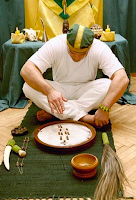
       I find it quite interesting the ways in which humans can use physical items to represent non-physical ideas or beliefs. Perez describes the ways that people of the Afro-Caribbean religion Lucumi use food that they themselves prepared to appeal to and strengthen their connection to their deities, the Orishas, and the spiritual realm. Some claim that when the offerings are taken back they weigh less than they had before being given out to the Orisha, although in most cases it cannot be physically noted in any way that these offerings are being interacted with and appreciated (unless someone is possessed and eats the food as the deity in the body of one of the followers). Despite this, the practice is still incredibly important and relevant to their usual rituals.  Lucumi man performing a religious ritual https://link.springer.com/referenceworkentry/10.1007/978-1-4614-6086-2_9109      Seeing and eating is said to overlap metaphorically in rela...

Cooking for the Dead

Image
 While the vast majority of the most intricate rituals described by Perez in the text were the cooking done for the Orisha, a variety of things were practiced by the Lucumi that she spent time with also practiced a form of ancestor worship as part of their religion, which involved offering a part of the food that they cooked to each of the ancestors present, a process with it's own unique and intricate ritual practices and taboos. While this is a very formal way of food being used to connect with the deceased, it's definitely not the only example of it that springs to mind when I think on the concept.  Personally, the first thing that I think of when it comes to food and to the dead, together, is a friend of the families who passed away when I was in high school. She wasn't someone I was particularly close to, the mother of my mom's best friend who I saw maybe once or twice a year when she came to Massachusetts to visit her daughter and Grandchildren. She was close enou...

Our roles

Image
   Image by Andreas Schalber https://www.bischoferhaus.at/en/ Much like Aroma of righteousness , Religion in the Kitchen was a new reading experience for me. And once again, that is far from a bad thing. While admittedly I could never really see myself or any of the people of color I know taking part in Lucumi, I could definitely see them being inspired by it's practices much in the same way I was. The book does an amazing job going over the history, beliefs, and origins of Lucumi as it made its way to the states.  What really got my attention though was the section in the book about kitchen roles and how in Lucumi, men handle the 4-legged animals for food while women handle the 2-legged ones. Switching the roles or having both genders do both types of work seems to be okay for some Lucumi communities but just flat out wrong sounding for others like that one cuban priestess named Elaina comes from. Afterwards, the section goes on in detail about all the different roles e...

Tatse - Heart, Liver, and Lungs

Image
This reading has probably been one of my favorites so far, not because of the fact that it is about taste necessarily, but because it discusses a kind of food that I enjoy while many others do not. It also discusses it in a wonderfully graphic way which, as someone who has spent a lot of time in many different kitchens, I find very entertaining. The description of Arlene and the elders dissecting the poultry actually made me hungry while it probably did the exact opposite for other readers. I have a love for eating the innards of animals, specifically poultry. I am not the kind of person who would eat brains, that freaks me out, but I am the kind of person who loves haggis. Haggis, for those of you who don't know, is a sheep's heart, liver, and lungs, minced with onion, oatmeal, suet, spices, and salt, mixed with stock, and traditionally encased in the animal's stomach and boiled. Maybe I like it because I am Scottish but not all Scottish people actually like haggis. I...

Women are “cool”, Gordon Ramsay is “hot”

Image
“Only women, envisioned as constitutionally and temperamentally ‘cool,’ can manage ShangĂł’s achĂ© in the heat of the kitchen.” For some reason, this quote stuck out to me. I couldn’t get it out of my head because all that it makes me think about is Gordon Ramsay. Forgive me. Gordon Ramsay has got quite the temper and has surely been described as “hot-headed.” When reading, I was thinking about the contrast between the kitchens in the text and the kitchens portrayed on television, and I couldn’t help but think about how the centrality of women's cooking is so different. For reference, one of the winners of MasterChef said that “It’s a really tough industry and not female-friendly” when referring to professional cooking.  I figured that this blog was the perfect place to add a video of Gordon Ramsay’s temper, but I want to bring in another quote from Perez’s Introduction that made me think of a specific season of MasterChef: “The very physicality of food preparation has militated agai...

The Ironies of Religious Cooking

     The most shocking part of PĂ©rez's account of cooking for the deities in the Yoruba religion for me was the ironies involved, especially in the constituents' positive attitudes towards servitude. As this community has experienced the abuse of slavery in its history and undoubtedly still feels the effects of this injustice today, this positive attitude confused me. In fact, laborers ensured that their "masters" could eat, turning the most bland and boring ingredients into something actually palatable, yet their masters have completely whitewashed them and depicted them as lacking culture. Talk about the irony in that!       When PĂ©rez details the rites of passage that initiates had to take, doing the dirty work of gutting animals, it becomes apparent that this custom – almost like the act of hazing – is actually viewed in a positive light in the ilĂ©. Completing these undesirable trials is recognized as an act of becoming part of the larger comm...

Taste and Baby Taste Buds

I’ve never really been one for things with really delicate tastes, things like flavored water and often floral foods and drinks were not for me. They just didn’t pack enough of a punch, felt too much like a suggestion of the fruit or flower it was supposed to taste like, they don’t have enough flavor to justify that much texture. However, for Mother’s Day my sister baked a booooooomb rose cake and I have not been able to stop stuffing my face with it. It is white cake with a little bit of rose jam in the batter, rose and strawberry jam separates the layers, and it is decorated with rose buttercream and fondant roses. It is incredible, and as I scarf it down at near violent speeds, and in this moment I am so grateful that my taste buds have grown in their appreciation. I was a very picky kid, with lots of flavors I didn’t like and textures that I couldn’t stomach. In class we discussed how children are often very sensitive to foods, and that their pickiness is often a safety mechanism. ...

Taste

Taste is one of my favorite of the senses just because I feel as though it is something that can make us feel at one with each other. It is one of the senses in which we are able to bond while making a dish, or sitting down eating enjoying not only the food but the company with the people who you are with. Elizabeth Perez wrote a book, Religion in the Kitchen: Cooking, Talking, and the Making of Black Atlantic Traditions, where she talks about and touches upon the importance of religious cooking. She also talks about the importance of what religions do in order to prepare certain foods or certain foods/ drinks for ceremonies. Growing up in a Catholic setting we used to bless the body of Christ and the blood of Christ before we would be able to accept it. You would bring these items down the aisle and then the priest would have us join in prayer to bless the items. We use communion in the church to be able to have and feel the presence of God. We talked about this in class where some ...

Tasting the Body and Blood of Christ

My personal favorite... Taste. Taste is such a beautiful thing in our lives. We, as humans, survive off of eating and drinking, which means we are constantly tasting different things all throughout our lives, the good and the bad... Throughout Religion in the Kitchen : Cooking, Talking, and the Making of Black Atlantic Traditions , written by Elizabeth Pérez, she touches upon the importance of religious cooking, which leads me to my point on how religions have certain food or drinks that are taken during religious ceremonies that are extremely important to those who engage in them.  Within the religion of Christianity, on the first Sunday of every month Christians engage communion. During this religious act bread and wine is passed around. When they take a bite of the bread, it is supposed to represent the body of Christ, and when they drink the wine, it is supposed to represent his blood as he was crucified on the cross. As a result communion is done in the remembrance of eac...

Gods in the Kitchen

Image
At the risk of sounding hubristic, human beings are imbued with a portion of divine power in the kitchen. We manipulate the elements of fire, air, and water to transform one thing into another. We feel like ancient herbalists when we fine tune the spicing of our dishes, and we usually do it to satisfy ourselves and other humans, not to glorify God. It's impossible to not think of burnt offerings when you're grilling and the flames jump to lick at the delectable meat, and smoke rises up to the heavens (or your fume hood). Cain and Abel offering their sacrifices Gustav Dore, 1866 It could be said that that which is pleasing to the tastes of man is often pleasing to God. In Judaism, he loves oxen, sheep, and goat, and enjoys the covenant which produces "the “soothing odor”  of sacrifice" (Green, 117). In Lucumi  religion, the Oricha, like us, have their  favorite foods, and exceptions. What one Oricha may find pleasing, another might find repugnant. Simila...

Tasting in Life:

Image
As I have stated in previous blog posts, I have had a life relatively devoid of religion so a lot of my initial thoughts when it comes to the senses does not immediately see the deep connective tissue between the two categories, yet taste and its associated ritual activities is one of the easiest connections that I have made. I understand how deeply comforting and powerful the act of preparing and eating a meal can be, it made sense faster to me than any of the others. There is something very special about this sense, and Perez captures it in her book, Religion in the Kitchen, with describing how the family she was working with had found their last house completely unsatisfactory due to the awkward and small design of their kitchen. The cooking process as well as food was so intertwined with their faith that could not be the same without. Just this year I have really started to get into cooking, I had done a lot before for jobs but that kind of sucks the enjoyment right out of the act...