Posts

Showing posts with the label darśan: seeing the divine image in india

Experience in Shaping what we See

Image
Rama & Sita India is a destination that I would love to travel to. Its rich culture and religious diversity shape much of the country’s ideals, customs, architecture, music, art, etc. Diana Eck, author of “Darsan: Seeing the Divine Images in India” describes India best when she says, “India presents to the visitor an overwhelmingly visual impression. It is beautiful, colorful, sensuous. It is captivating and intriguing, repugnant, and puzzling. It combines the intimacy and familiarity of English four o’clock tea with the dazzling foreignness of caparisoned elephants or vast crowds bathing in the Ganga during an eclipse. India’s display of multi-armed images, its processions and pilgrimages, its beggars and kings, its street life and markets, its diversity of peoples- all appear to the eye in a kaleidoscope of images” (10).  One of Frida Kahlo's Self Portraits I remember being mind blown about our vision when a challenge having to do with the color of a dress was goin...

Seeing is Believing <-- I wasn't the only one that thought of this

Image
The sense of sight is so important in how we perceive the world because humans rely on sight more than any other sense and sight interacts with all the senses to the highest degree. DarĹ›an: Seeing the Divine Image in India  describes how strongly sight is used in the religious contexts of Hinduism. DarĹ›an means "seeing" and is used to describe seeing religious sights. Many Hindus travel the world for the darĹ›an of a place of pilgrimage or the darĹ›an of famous deities. India has thousands of these places and statues that convey images of the various deities worshiped. Western tradition deems this religious practice as idolatry but "anyone who bows down to such things clearly does not understand them to be stick and stones," (21). In India's terms, seeing is knowing and one must see to know. It was also stated that people would believe the person that has "seen it" over the person that has "heard it".   Diana Eck also spoke of the ambig...

Sight, Duality, and Hinduism

Image
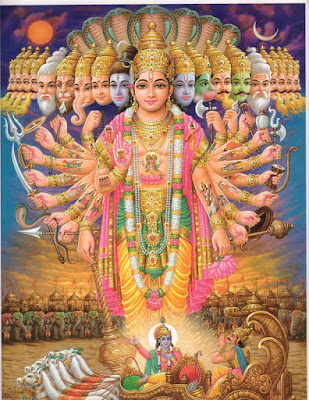
“Hindu thought is most distinctive for its refusal to make the one and the many into opposites. For most, the manyness of the divine is not superseded by oneness. Rather, the two are held simultaneously and are inextricably linked.” (Eck, pg. 28) The section of DarĹ›an: Seeing the Divine Image in India was really interesting to me. Usually when you see something you take it as face value, instinctively categorizing it into whatever niche your brain thinks it fits. We divide animals, plants, objects, even other humans into often arbitrary categories when our vision goes unchecked. In such a sight-based religious practice, it would be easy to see how one could think of deities as unattached to each other, each having distinct and separate attributions mutually exclusive with others. However, in Hinduism, this difference does not mutually exclude oneness. When explaining away the visual distinctions we make between humans, whether it be due to race or gender or body shape or some other v...