Posts

Showing posts with the label #CourtneyBodeen

Final Blog Post

   I just tried to find an image that could potentially encapsulate "Smells and Bells," and I found a photo of a guy with the words smells and bells next to him but I couldn't use it. Smells and Bells was a phrase I had never heard of until taking this class, and I only just learned that it is in fact a phrase and not just the title of this delightful course when completing said Google search. Regardless, I went into this course having taken either 4 or 5 classes with Professor Darling. I can't remember if it's 5 or not. Anyways, when searching for a class to take my final semester, I found Smells and Bells and thought huh. That sounds really fascinating. Because it makes sense (haha) that the senses would be heavily intertwined in religious experiences, rituals, and culture, I did not know to this extent how much it really does have an effect on how someone may interact with their faith. Not only even in religion- I had never really put this much thought into my ...

Is Seeing Believing?

       Do we have to see something to believe it? Well, that depends on what it is you are trying to believe. Simply viewing something may just serve to confirm your previous notions of what you had already imagined. We can't really see wind, and we don't have a lot of wind-deniers. Of course, that's an obvious example, because we can feel it. If another sense can confirm the existence of something, do we really need to have the others involved? Diana L Eck argues that "Seeing is not a passive awareness of visual data, but an active focusing upon it, "touching" it" (Eck 15). The way she describes it as "touching" this data is fascinating to me. Going back to that phrase, "I have to see it to believe it," it holds true sometimes! Vision as touch can be really affirming! Touch is one of the strongest senses because when something is tangible there's not a lot of room for debate as to whether it exists or not, or what it looks like. ...

The Evolution of Worship Music

Image
           Anne Rasmussen's examination of the Qu'ran and music and how it both interacts with this sort of feminism through women being the leaders of performances and teaching songs to their community and how Islamic music has evolved made me want to talk about the evolution of worship music, from hymns to Christian music festivals. I remember being surprised when I attended a service at LifeChurch, a non-denominational (I believe- they may be more Evangelical but the one I went to said they were non-denominational) church at how modern it was. It didn't even take place in a stereotypical chapel or church, it was actually in a retirement home. My bewilderment at this setting was even a subject of discussion because the pastor then went on to say that church is "us." It's not a physical location, it's the community. Anyways, I digress.      Aside from the lack of pews and stained glass, I was even more pleasantly surprised when it went to wo...

Are Sweet Things Deceptive?

  "Bread, grapes, milk, honey: it is difficult not to see here little more than the fruitful—if not always tasteful—extension of many of Scripture’s most sweet-tasting metaphors"  (Fulton 184)     Sweet tastes have always been used to convey goodness; when we say "that's so sweet," it's a really good thing! So it is no wonder that sweetness is a high form of pleasantry and "goodness." When someone is feeling sour, that is a negative connotation. We're programmed to prefer sugary sweetness over bitters or sours: our bodies recognize sweet things as a source of calories, because sugary things, such as berries, typically have a good deal of calories. We can thank our ancestors that foraged for food for our ability to recognize sweetness because it enabled them to be fruitful and multiply because they were able to sustain themselves. Get it? Fruitful? However, anthropologist Stephen Wooding notes that our inate ability to detect sweetness and crave...

Why Touch Matters- And Why It's So Powerful

 It is no surprise that touch has been an important factor in well-being throughout history. The lack of physical touch, especially as a child, has been shown to lead to oversensitivity, hostility, depression, loneliness, and more. There is a reason that most newborn babies are placed on the stomach after birth—it provides comfort to both parties, allows the infant to become familiar with the scent of its parents, allows for a smooth transition into breastfeeding, and also releases oxytocin. Touch is a nurturing interaction between individuals, and it provides a strong ground for bonding and communication, as well as affirms social bonds, for example, receiving a handshake from an employer, or high-fiving a teammate after a game. It can also yield negative social bonds, as Constance examines in  The Deepest Sense, with pain being used to enforce religious expectations.  Physical touch can be as intimate as a handshake or a clasp of the shoulder, to kissing or sex. The int...

When Pigs Fly and Rosemary Focaccia

Image
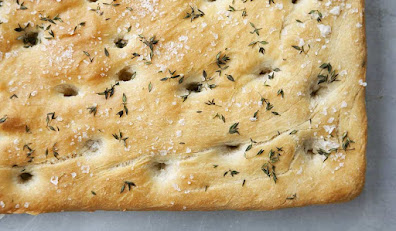
  When I watch the Great British Bake Off/Baking Show (which, admittedly isn't that often, but when such an occasion occurs, for example, when my housemates or friends watch it) I can practically sniff the ingredients through the screen. I've always been good at picking apart ingredients just through my nose, though no one should ever dare test me on that. When I walk into a Subway or any deli, I melt. No, it's not the roast beef or meatballs, it's the smell of Italian Herb & Cheese bread. Italian seasoning, with its oregano, basil and thyme; they're all very distinct scents that have always stood out to me, along with baked bread in general, which leads to no surprise that one of my favorite places to exist in is When Pigs Fly. There are so many loaves of bread. So many oils and jams. I could pick apart the herbs in a focaccia, and one particular scent that I can always identify is rosemary. I have at least two people that can fact-check me on this, that have b...